
Section C, story 44 min read
A tornado warning in the suburbs, a blizzard on the lakefront, a missing child: when an emergency hits the Chicago area, warnings arrive through several channels at once. Your phone buzzes, the TV interrupts a program and a weather radio on the kitchen counter sounds an alarm. Each of these is a separate system with its own rules. Knowing which is which helps you decide how to set up your home, your phone and your car.
The three systems
| System | Where you get it | Rules | Needs |
|---|---|---|---|
| Emergency Alert System (EAS) | TV, radio, cable and satellite | 47 CFR Part 11 | Nothing: alerts interrupt programs |
| Wireless Emergency Alerts (WEA) | Mobile phones | 47 CFR Part 10 | A WEA-capable phone |
| NOAA Weather Radio | Special weather receivers | National Weather Service | A weather radio |
On TV and radio: the Emergency Alert System
The FCC’s rules list the broadcasters and providers that take part in the Emergency Alert System. They include AM, FM and low-power FM radio stations, TV stations including Class A and low-power stations, cable systems, satellite TV and satellite radio, among others. That covers every station in Chicago TV Channels: The Local Stations You Can Watch With an Antenna and Chicago Radio Stations by Frequency: FM and AM From Bottom to Top, whether commercial or public.
Every EAS message follows the same four-part pattern set out in 47 CFR 11.31: a preamble and coded header, an attention signal made of two tones played at once, the message itself, which may be audio, video or text, and an end-of-message code. That is why alerts on different stations sound so alike. TV stations must carry video messages as well as audio, which helps viewers who are deaf or hard of hearing.
On your phone: Wireless Emergency Alerts
The National Weather Service describes Wireless Emergency Alerts as emergency messages sent by authorized government alerting authorities through your mobile carrier, arriving with a unique sound and vibration. You do not need to sign up or download anything; a WEA-capable phone in the affected area receives them automatically. The Weather Service also provides information about the alerts in Spanish.
The FCC’s rules at 47 CFR 10.400 sort the alerts into classes, and 47 CFR 10.280 decides which ones you can switch off:
| Alert class | What it is for | Can you opt out? |
|---|---|---|
| National Alert | Issued by the President, the President’s designee or the FEMA Administrator | No |
| Imminent Threat Alert | Urgent, severe threats to life or property, such as tornado warnings | Yes, if your carrier offers it |
| AMBER Alert | Child abductions meeting the Justice Department’s criteria | Yes, if your carrier offers it |
| Public Safety Message | Essential advice that helps save lives or protect property | Yes, if your carrier offers it |
Tip: Before you turn off Imminent Threat Alerts because of a late-night buzz, remember that in the Chicago area these are how many severe storm and tornado warnings reach phones. A weather radio set to your county is a quieter alternative at night, but it only covers weather and the emergencies the Weather Service relays.
At home: NOAA Weather Radio
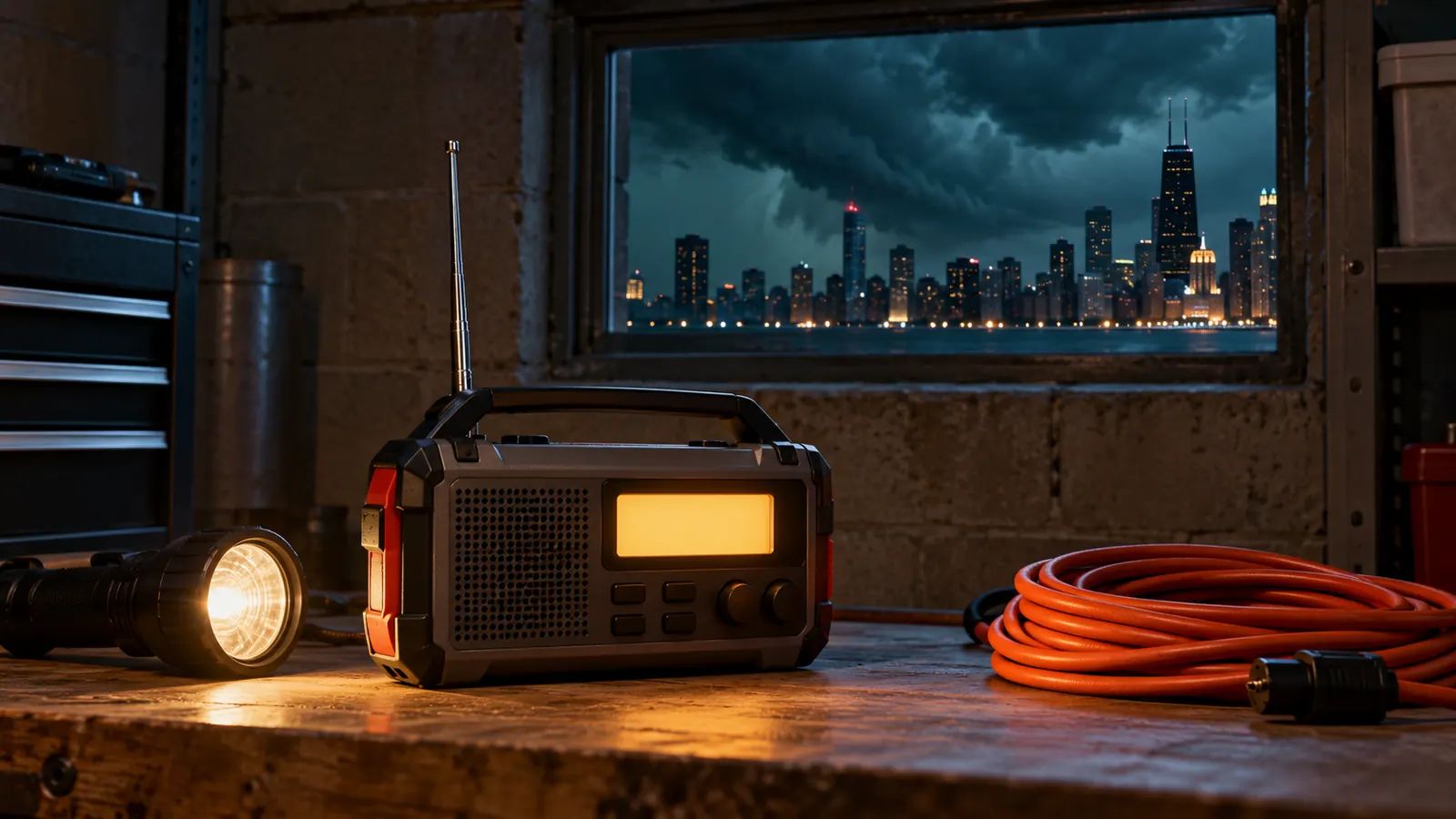
NOAA Weather Radio broadcasts National Weather Service warnings, watches and forecasts 24 hours a day, and working with the FCC’s Emergency Alert System it also carries other hazards. The transmitter for Chicago, KWO39, is on 162.550 MHz and covers Cook, DuPage and Lake counties, according to the Weather Service’s transmitter data. Suburban transmitters include Lockport on 162.425, Crystal Lake on 162.500 and Plano on 162.400. The full table is in Chicago Weather on TV and Radio: Lake Effect Snow, Warnings and Weather Radio.
A weather radio with an alarm and county coding is the one alert source designed to wake you up for a warning in your county and stay silent otherwise. Keep batteries in it, because storms that trigger warnings often cut the power too.
Which one to rely on
| Situation | Best source |
|---|---|
| Asleep at night | Weather radio with alarm, or phone alerts left on |
| Driving | Car radio and phone alerts |
| Power out | Battery weather radio or battery AM/FM radio |
| Want details after the alert | Local TV newscasts or all-news radio |
The honest answer is to use at least two. Alerts are short; they tell you that something is happening and what to do right away. Details such as which areas are affected, which roads are closed and when the danger has passed come from local newscasts and the Weather Service. WBBM Newsradio, on 780 AM and 105.9 FM, describes itself as Chicago’s all news station, which makes it a natural choice in the car.
When an alert arrives
- Read or listen to the full message, including where it applies.
- Act on the instructions first, then look for details.
- Turn to a local station or the National Weather Service for updates.
- Check that any alert you share with friends is current before you forward it.
Tests and family plans
All three systems are tested from time to time, and a test identifies itself as a test. If you are unsure whether an alert is real, check a local news station before reacting to rumors. It is also worth showing children and older relatives what a phone alert looks and sounds like, and agreeing in advance where the family will gather and who will check on whom.
In a city where weather can turn quickly off the lake, a few minutes of setup, a weather radio programd for your county and phone alerts left on, is one of the simplest safety steps there is.