
Section A, story 25 min read
Spin a radio dial anywhere in Chicagoland and you pass dozens of stations. Some are licensed to the city, others to suburbs such as Evanston, Skokie, Oak Park and Aurora, and a few that sound local are really simulcasts of an AM station on an FM frequency. This guide lists the main stations in dial order, using the FCC’s Public Inspection File for the frequency, call sign and community of license. Where a station describes itself on its own website, that description is included; where it does not, we simply list the facts.
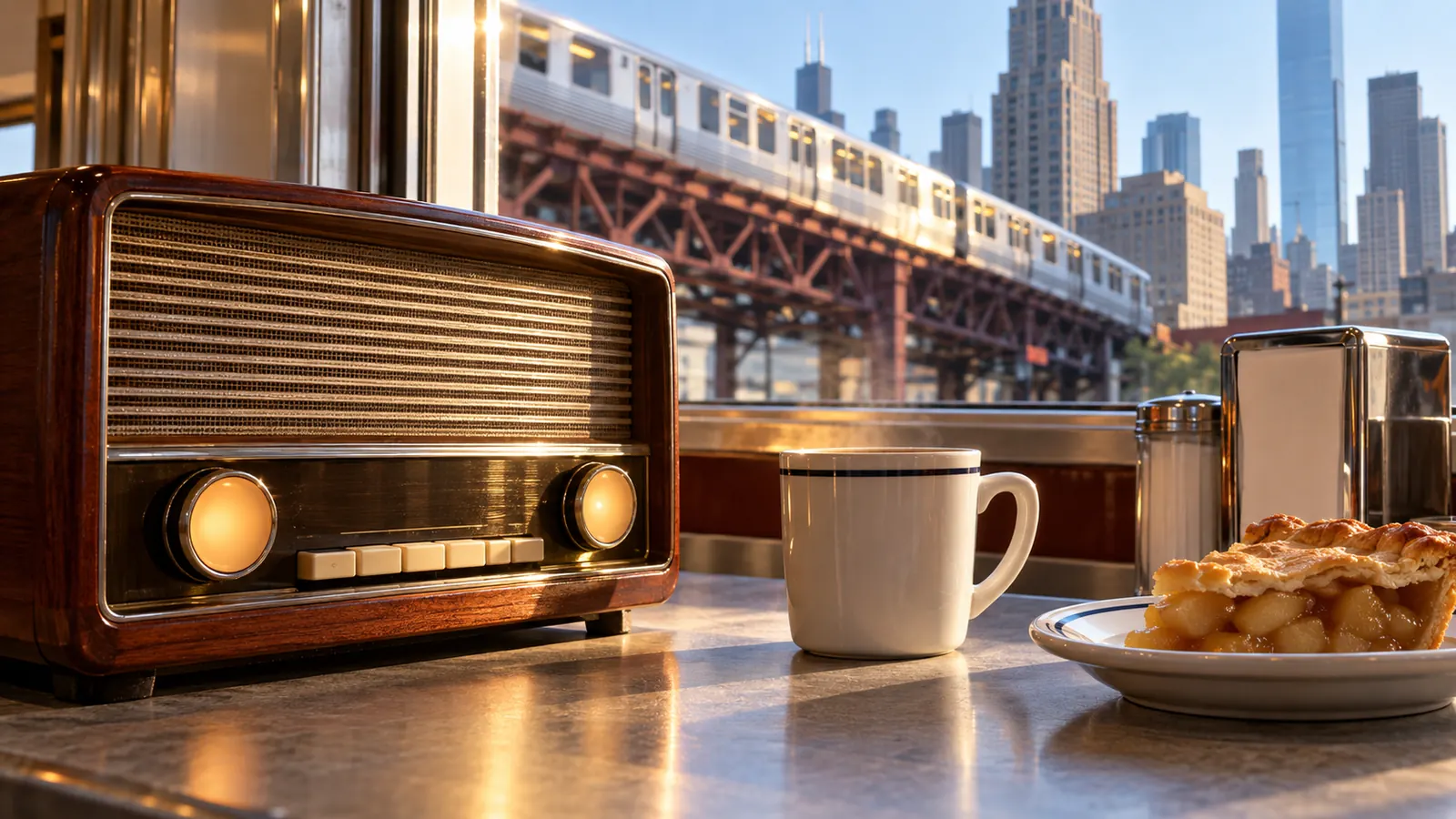
How the FM band is laid out
Under the FCC’s rules, the FM band runs from 88 to 108 MHz and is divided into 100 channels of 200 kHz each, numbered 201 to 300. The bottom slice, from 88.1 to 91.9 MHz, is set aside for noncommercial educational stations. That is why the public, college and university stations in Chicago are clustered at the left end of the dial, and the commercial music and talk stations start just above 92.
The noncommercial end: 88.1 to 91.9
| Frequency | Call sign | Licensee | City of license |
|---|---|---|---|
| 88.7 | WLUW | Loyola University of Chicago | Chicago |
| 89.3 | WNUR-FM | Northwestern University | Evanston |
| 90.9 | WDCB | College of DuPage | Glen Ellyn |
| 91.5 | WBEZ | Chicago Public Media | Chicago |
WBEZ is the station most Chicagoans mean when they talk about public radio. The others are run by colleges and universities and tend to have smaller coverage areas, so how well they come in depends on where you live. Our guide to Public Radio and TV in Chicago: WBEZ, WTTW, WFMT and the College Stations explains who runs the city’s public stations.
Commercial FM: 92 to 108
| Frequency | Call sign | Licensee | City of license |
|---|---|---|---|
| 93.1 | WXRT | Audacy | Chicago |
| 93.5 | WVIV-FM | Univision Radio Stations Group | Lemont |
| 93.9 | WLIT-FM | iHeartMedia (IHM Licenses) | Chicago |
| 95.9 | WERV-FM | Alpha Media | Aurora |
| 96.3 | WBBM-FM | Audacy | Chicago |
| 97.1 | WDRV | Chicago FCC License Sub | Chicago |
| 98.7 | WFMT | Window to the World Communications | Chicago |
| 99.5 | WUSN | Audacy | Chicago |
| 101.1 | WKQX | Radio License Holdings | Chicago |
| 101.9 | WTMX | Chicago FCC License Sub | Skokie |
| 102.7 | WVAZ | iHeartMedia (IHM Licenses) | Oak Park |
| 103.1 | WPNA-FM | Alliance Radio | Evanston |
| 103.5 | WKSC-FM | iHeartMedia (IHM Licenses) | Chicago |
| 104.3 | WSCR-FM | Audacy | Chicago |
| 105.1 | WOJO | Tichenor License Corporation | Evanston |
| 105.9 | WCFS-FM | Audacy | Elmwood Park |
| 106.7 | WPPN | Univision Radio Stations Group | Des Plaines |
| 107.5 | WGCI-FM | iHeartMedia (IHM Licenses) | Chicago |
| 107.9 | WLEY-FM | WLEY Licensing | Aurora |
A few of these describe themselves clearly. WXRT’s page calls it 93XRT and Chicago’s finest rock station. WFMT presents itself as Chicago’s classical and folk music station, and it is licensed to the same nonprofit that runs WTTW. WPNA-FM’s site calls it Polskie Radio 103.1 FM Chicago. For the Spanish-language and Polish stations on this list, see Spanish and Polish Language Radio and TV in Chicago.
AM stations
| Frequency | Call sign | Licensee | City of license |
|---|---|---|---|
| 560 | WIND | Salem Media of Illinois | Chicago |
| 670 | WSCR | Audacy | Chicago |
| 720 | WGN | Tribune Media Company | Chicago |
| 780 | WBBM | Audacy | Chicago |
| 820 | WCPT | Heartland Signal | Willow Springs |
| 890 | WLS | Radio License Holdings | Chicago |
| 1000 | WMVP | Good Karma Broadcasting | Chicago |
| 1030 | WNVR | Polnet Communications | Vernon Hills |
| 1200 | WRTO | Latino Media Network | Chicago |
| 1690 | WVON | iHeartMedia (IHM Licenses) | Berwyn |
AM frequencies are measured in kilohertz, so 720 means 720 kHz. Two of the big Chicago AM names, WGN and WLS, trace their call letters back to 1924; A Short History of Chicago Broadcasting: WGN, WLS and WTTW tells that story.
AM stations you can also hear on FM
Two of Chicago’s best-known AM stations now have an FM home as well. WBBM Newsradio’s own page lists both 780 AM and 105.9 FM, which matches the FCC record for WCFS-FM at 105.9, also licensed to Audacy. The sports station The Score added 104.3 FM in February 2026: Audacy announced that 104.3 The Score would simulcast 670 The Score, WSCR-AM, while the AM signal stays on the air. The FCC lists the FM station as WSCR-FM, licensed to Chicago.
Tip: If AM reception is noisy inside a building, try the FM simulcast first. FM is far less affected by the electrical noise from lights, chargers and appliances that often swamps AM indoors.
HD Radio channels
Some stations also broadcast extra digital channels, shown as HD2 or HD3 on radios that support HD Radio. ESPN Chicago is an example: the Chicago Bears and the White Sox both list its home as AM 1000 and FM 100.3 HD2. An ordinary FM radio tuned to 100.3 will not play the HD2 channel; you need an HD Radio receiver, which many newer cars have built in.
Why the city of license matters less than you think
The FCC licenses each station to a community, but the signal does not stop at the town line. WTMX is licensed to Skokie and WVAZ to Oak Park, yet both are heard across the city. For listeners the useful facts are the frequency and how strong the signal is where you are. If a station fades in and out, it may be a smaller college station, a station licensed far out in the suburbs, or simply a building or hill in the way.
Getting the most out of FM in the city
- Extend a radio’s telescopic antenna fully and try it both upright and at an angle.
- Move the radio away from TVs, computers and phone chargers, which add noise.
- In a tall building, a window facing downtown or facing the station’s direction usually helps.
- For a home stereo, a simple wire FM antenna pinned high on a wall can make a clear difference.
Frequencies change rarely, but formats and names change more often. The call sign and frequency in the FCC’s files are the reliable anchor; if a station you remember seems to have vanished, it may simply have changed its name while staying on the same spot on the dial.