
Section B, story 15 min read
Living twenty floors up should be great for TV reception, and often it is. Height clears trees and low buildings, and a window with an open view can pull in nearly every station in the market. But high-rises also bring their own problems: steel and concrete that block signals, tinted glass, neighbouring towers that bounce signals around, and building rules about what you can put on a balcony. Here is how to work through them.
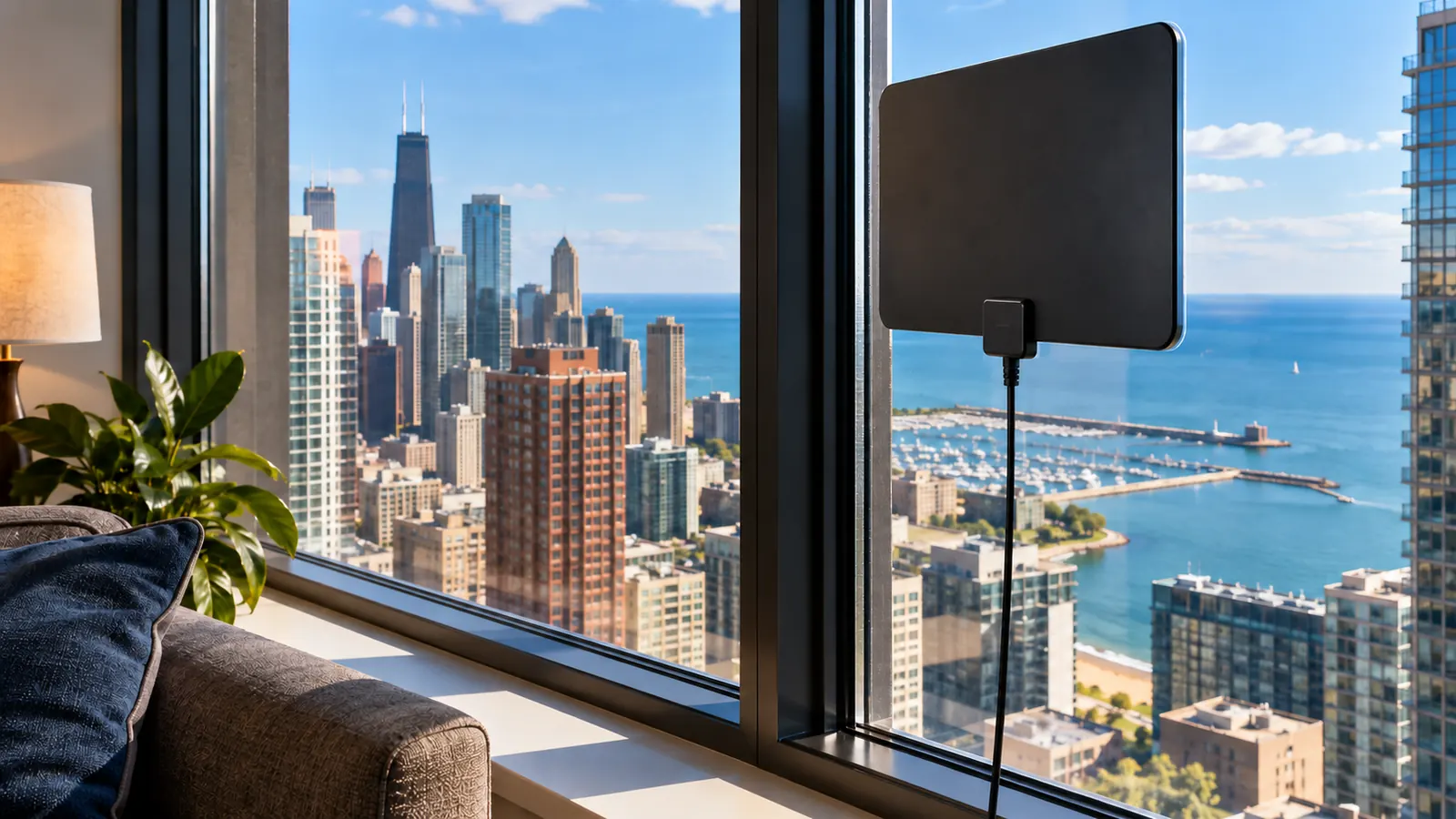
Start with the right kind of antenna
The single most common complaint from Chicago antenna users is that everything comes in except CBS. The reason is technical, not personal. According to the FCC’s public files, WBBM-TV, CBS Chicago on virtual channel 2, transmits on RF channel 12, which is in the high VHF band. Nearly every other major Chicago station, including NBC 5, ABC7, WGN, WTTW and FOX 32, is on UHF. Many flat indoor antennas are designed mainly for UHF and handle VHF poorly.
Tip: Before you buy, check the box or the product page for the words VHF and UHF. If it only promises UHF, or says nothing about VHF, expect trouble with channel 2.
Beyond that, you do not need anything exotic. Amplified antennas help when a long cable run or a splitter weakens the signal, but they cannot create a signal that is not reaching the antenna in the first place, and too much amplification can overload a tuner when you are close to strong transmitters. In a tall building, try the antenna without the amplifier first, then with it, and keep whichever gives you more channels.
Find the best window
In a high-rise the window matters more than the antenna. Concrete floors and steel frames block a lot of signal, while glass lets most of it through. Some energy-saving window films and tinted glass contain metal layers that can weaken reception, so a clear pane is better than a coated one if you have the choice.
- Place the antenna flat against the glass, as high in the window as you can.
- Run a full channel scan and write down the channels you receive.
- Move the antenna to another window, scan again and compare the lists.
- If two windows each bring in different stations, try a corner or a spot between them.
- Once you find the best spot, rescan one more time and leave the antenna there.
A window facing the direction the signals come from usually wins, but tall buildings next door can reflect signals from unexpected sides. Testing is quicker than guessing. Keep a note of which window gave which channels; it saves time if a station changes frequency later and you need to start again.
Balconies: what the FCC’s antenna rule covers
The FCC’s Over-the-Air Reception Devices rule, at 47 CFR 1.4000, limits restrictions that impair your ability to install, maintain or use an antenna to receive TV broadcast signals. It applies to property within your exclusive use or control where you have an ownership or leasehold interest. In plain terms, that usually covers the inside of your unit and a balcony or patio that only you use, whether you own the condo or rent the apartment.
The rule says a restriction impairs reception if it unreasonably delays or prevents installation, unreasonably increases the cost, or prevents an acceptable quality signal. Restrictions can still be allowed when they are needed for a clearly defined safety objective, or to preserve a building or district listed or eligible for listing on the National Register of Historic Places. That second point can matter in older buildings and historic districts.
Roofs and shared areas
The rule protects antennas in space you exclusively control. A roof, a hallway or an exterior wall shared by all residents is usually common property, so the building or the condo association decides what goes there. If you want a rooftop antenna, ask management. Some buildings already have a shared antenna system feeding every unit, and a cable outlet in your wall may carry free broadcast channels without any cable subscription. Ask before you assume the wall jack is useless.
Safety on a balcony
A balcony antenna should be secured so wind cannot carry it off, which matters a great deal many floors above a sidewalk. The U.S. Consumer Product Safety Commission has also warned about the hazard of antennas and ladders touching overhead power lines; its advice is to keep the distance from an antenna or mast to a power line at least one and a half times the height of the antenna or pole, and to properly ground masts according to electrical codes. Power lines are less of an issue on upper floors, but the grounding advice applies to any outdoor mast.
Cables and splitters
Every foot of coaxial cable and every splitter costs some signal. If you feed more than one TV from one antenna, a splitter halves what each set receives, which is when an amplifier earns its place. Use a short, good-quality cable from the antenna to the TV where you can, and avoid running it next to power cords.
When nothing works
Some units, especially low floors surrounded by taller towers or rooms facing an interior courtyard, simply do not get a usable signal. Before giving up, try one more window and a VHF-capable antenna, then check whether the building has a shared antenna feed. If not, the free apps and streams most Chicago stations offer may be the practical answer; How to Watch Chicago Local News Without Cable lists them.
A quick checklist
| Problem | Likely cause | What to try |
|---|---|---|
| All channels except 2 | UHF-only antenna | Antenna rated for VHF and UHF |
| Channels come and go | Weak or reflected signal | Higher in the window, another window |
| Fewer channels with amplifier on | Tuner overload | Turn the amplifier off |
| No channels at all | Input set to Cable, or no scan | Set input to Antenna and scan |
| One station vanished | Station changed RF channel | Full rescan |
For the full line-up you should expect to find, see Chicago TV Channels: The Local Stations You Can Watch With an Antenna. And if you are shopping for a new TV at the same time, NextGen TV in Chicago: What ATSC 3.0 Means for Antenna Viewers explains what the NextGen TV logo on the box means for antenna viewers.